
Yellow Jackets in Massachusetts: Why They Turn Mean in Late Summer
Yellow jackets are wasps with sharp black and yellow banding, a smooth body, and no fuzz. That last detail is the fastest way to separate them from a bee. Honeybees and bumble bees are visibly hairy and move in a slow, loaded-down way. Yellow jackets look sleek and fly fast and direct.
Three yellow jacket species turn up in Massachusetts: the eastern yellow jacket, the German yellow jacket that arrived here in the 1970s, and the southern yellow jacket, which UMass Amherst notes is not especially common in the state right now. For a homeowner, the difference rarely matters. All three sting repeatedly, all three defend a nest hard, and all three follow the same yearly schedule.
Size is another tell. Yellow jackets run about half an inch. If the insect is noticeably bigger and black and white instead of yellow, you are probably looking at a bald-faced hornet, which is a different problem with a different nest.
Why Yellow Jackets Get Aggressive in August and September
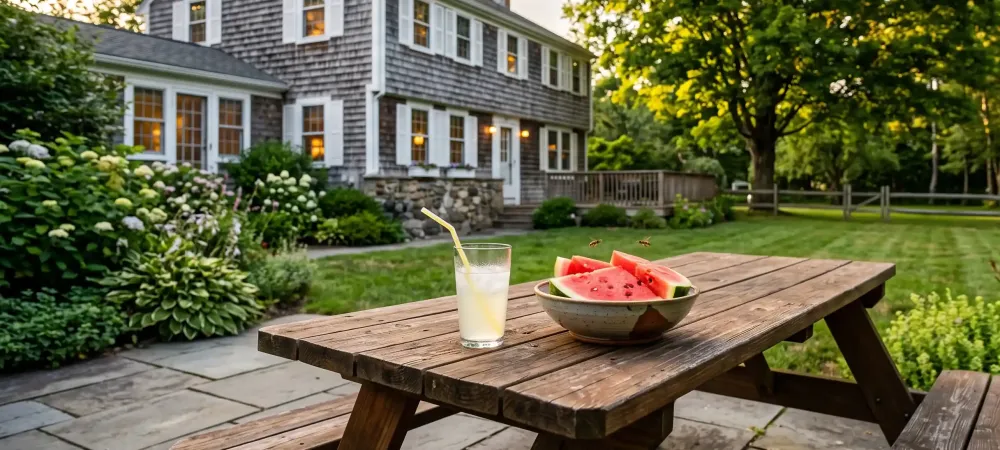
Yellow jackets turn aggressive in late summer because their food source changes. Through spring and early summer, workers hunt insect protein to feed developing larvae. Once the queen stops laying and the larvae are gone, that job ends and the colony switches to foraging for sugar. That is the point where yellow jackets start showing up at your cookout, your trash barrel, and your soda can.
Colony size makes it worse. A nest that started with one queen in April can hold thousands of workers by Labor Day. UMass Amherst puts the peak of yellow jacket and human conflict squarely around the late-summer holidays, and that timing holds year after year across eastern Massachusetts.
So the insects are not getting meaner in some personal sense. There are simply far more of them, they want the same sweet food you brought outside, and they have a large nest behind them worth defending. Every worker in that colony dies at the first hard frost, which is why the problem ends abruptly in late fall without anyone doing anything.
Where Yellow Jackets Nest Around Massachusetts Homes
Most yellow jacket nests around Boston-area homes are underground or inside a void you cannot see. Ground nests are the most common, often in an abandoned rodent burrow, under a shed, at the base of a retaining wall, or in a mulch bed. The entrance is usually a single hole with steady traffic in and out.
The nests that cause real trouble are the ones inside structures. Yellow jackets readily move into wall voids, soffits, ceiling cavities, and the space behind vinyl siding. Older housing stock across Quincy, Dorchester, and the South Shore gives them plenty of gaps to use, and a colony inside a wall is not something a homeowner can safely reach.
Yellow jackets do not reuse last year's nest. A new queen starts fresh each spring, so finding a nest in the same spot two years running means the location is attractive, not that the old colony survived.
Two Yellow Jacket Myths Worth Dropping
Fake decoy nests do not stop yellow jackets from nesting. The paper-bag lookalikes sold as territorial deterrents rest on the idea that wasps avoid a rival colony, and Penn State Extension is direct about the evidence: no clear evidence indicates that decoy nests actually prevent stinging paper wasps or yellow jackets from nesting. Hanging one gives you a false sense of coverage while a real colony builds twenty feet away.
Peppermint oil does not keep yellow jackets off your deck for a season either. Essential oils do have some measurable repellent effect, but it is measured in minutes. Clemson's review of the research found rosemary oil protected test subjects for roughly 15 minutes and lemongrass oil for about 40, and no study examined landscape plantings repelling insects at all. Spray a peppermint mix on your railing and it is gone before you finish eating.
Neither myth is harmless. Both send people into late August believing they have handled a problem, which is exactly when a mature nest near a doorway becomes a sting risk.
Yellow Jacket vs. Bald-Faced Hornet vs. Paper Wasp vs. Honeybee
That last card matters. Honeybees are beneficial, and when a honeybee colony is not an immediate threat, the right move is a beekeeper who can remove it alive rather than a treatment. Correct identification changes who you should be calling.
What Actually Reduces Yellow Jackets in Your Yard
Removing the food is the only prevention that reliably works. Yellow jackets forage where the sugar is, so the list below beats any spray you can buy:
- Keep trash barrels closed, latched, and rinsed a few times over the summer
- Cover food and drinks while you are outside
- Pick up fallen fruit under trees and berry bushes
- Move recycling and hummingbird feeders well away from the patio
- Wipe down the grill after cooking
Sealing entry points in spring is the second lever. Gaps around siding, soffit joints, utility penetrations, and vent screens are how colonies get into walls in the first place. Closing those in April and May is far easier than dealing with a 3,000-worker colony inside a wall in September.
Traps have a narrow use. Penn State Extension notes that yellow jacket traps can cut the number of foraging workers somewhat but are unlikely to solve the problem on their own. Traps placed at the far edge of a yard can pull some traffic away from a specific area. They will not clear a nest.
When a Yellow Jacket Nest Needs a Professional
Call a professional when the nest is near a doorway, walkway, garage, or play area, when it is inside a wall or ceiling, or when anyone in the house has a sting allergy. Those three conditions cover most of the nests we get called about across the Greater Boston area and the South Shore.
Ground nests within a few feet of where people walk are the ones that put people in the emergency room. A mower, a string trimmer, or a kid on a bike passing over the entrance can trigger a full defensive response from thousands of workers in seconds. Distance is what keeps you safe, and a nest by the front steps offers none.
Wall void nests need particular care. Sealing the exterior entrance without treating the colony first pushes the wasps inward looking for another exit, which is how they end up inside the house. A large colony left to die in a wall can also leave behind decomposition odor and staining. Our stinging insect control service uses a low-toxicity residual product and removes the nest when it is in a reachable spot, and treatments come with free retreatment if the problem comes back.
If you are weighing a DIY attempt on an exposed nest, our guide to whether wasps are actually dangerous covers the sting risk in more detail. Yellow jackets are also on the list of pests that pick up in the Boston area every fall.
Yellow Jacket Questions We Get Every August
No. Yellow jackets are wasps. Bees are fuzzy, feed on pollen and nectar, and rarely sting away from the hive. Yellow jackets are smooth, hunt insects and scavenge sugar, and sting repeatedly when a nest is threatened.
An eastern yellow jacket colony typically reaches 2,000 to 3,000 workers by late summer, and German yellow jacket colonies can pass 5,000. That number is why a mature nest near a walkway is treated as urgent.
Yes. Every worker dies at the first hard frost. Only newly mated queens survive, and they overwinter in sheltered spots and start new colonies the following spring in a different location.
Sometimes, and only with real caution. Treatment has to happen after dark when the workers are inside and their vision is poor, with an aerosol rated for wasps and hornets injected into the entrance hole, wearing heavy loose clothing and eye protection, and with an escape route planned. Skip it entirely if the nest is near a doorway, inside a structure, or if anyone in the household is allergic.
The colony has stopped raising larvae and switched from hunting protein to foraging sugar. Soft drinks, fruit, and open food become the target, so the wasps show up where people eat rather than where they nest.
It can. A crushed yellow jacket releases alarm pheromone that signals other workers, which is why guidance is to wash the site with soap and water after a sting rather than swat repeatedly near a nest.
Species and seasonality guidance current as of 2026.