
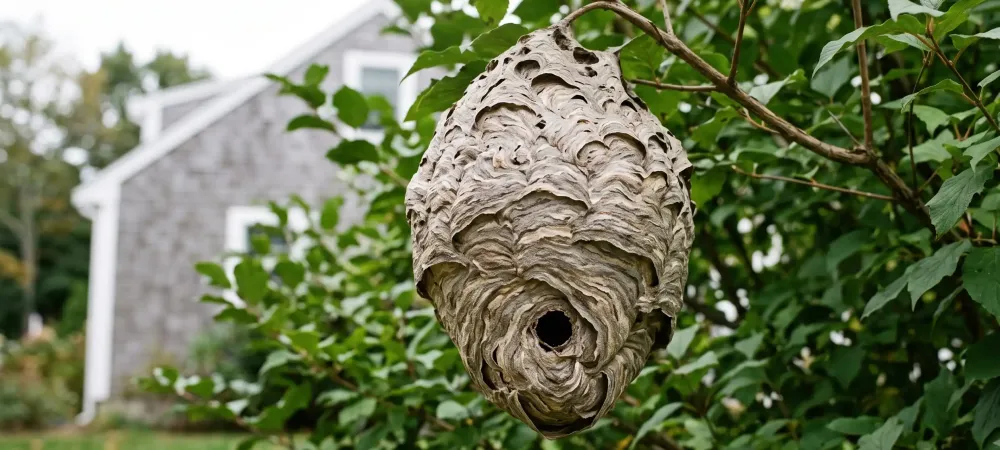
Bald-Faced Hornets: What That Gray Football Nest in Your Tree Actually Is
The bald-faced hornet is a yellow jacket, not a hornet. Cornell's Integrated Pest Management program is blunt about it: despite the common name, bald-faced hornets are large black and white yellow jackets, in the same family as the yellow jackets that raid your cookout. The scientific name is Dolichovespula maculata.
That correction is more than trivia. It tells you how the insect behaves, because it behaves like a yellow jacket. It defends its nest hard, it stings repeatedly rather than once, and the whole colony dies off at the first hard frost. People who hear "hornet" often picture something exotic and permanent. What is actually in the shrub is a native wasp on a one-year clock.
Massachusetts has exactly one true hornet, the European hornet, and it looks completely different. European hornets are brown and dull yellow and nest in hollow trees and wall voids. A black and white wasp hanging around a gray paper ball is a bald-faced hornet every time.
How to Identify a Bald-Faced Hornet
Bald-faced hornets are black with ivory-white markings on the face, thorax, legs, and the tip of the abdomen, and they run 5/8 to 7/8 of an inch long. The white face is the giveaway. No other stinging insect in eastern Massachusetts has that stark black-and-white color pattern at that size.
The body is smooth rather than fuzzy, which separates bald-faced hornets from any bee. They fly fast and purposefully, and a worker returning to the nest usually goes straight in without hovering.
Size can be misleading in the moment. Bald-faced hornets look considerably bigger than a common yellow jacket, and a queen is larger still. That size difference is why homeowners often assume they have something dangerous and unusual on their hands rather than a native wasp.
What a Bald-Faced Hornet Nest Looks Like and Where They Build
A bald-faced hornet nest is a gray, football-shaped or teardrop-shaped paper ball with a single small opening near the bottom. The queen builds it from chewed weathered wood mixed with saliva, which is what gives it the layered gray papery texture. Inside are stacked tiers of comb wrapped in a protective outer envelope.
Nests get large. Penn State Extension documents nests reaching up to 24 inches tall and 18 inches across. Most are placed at least three feet off the ground, and they range from low shrubs and hedges right up into tree canopies over 60 feet high. Nests under eaves, on porch ceilings, and in dense foundation plantings are the ones that put people close to the entrance without meaning to.
Colonies are smaller than the nest size suggests. A mature bald-faced hornet colony holds roughly 100 to 400 workers, well under the two to five thousand a ground yellow jacket colony can reach. The nest is big because of all that paper envelope, not because of an enormous population inside.
Bald-Faced Hornet Nests Are Abandoned Every Winter
A bald-faced hornet nest is used for one season and never again. Workers and the old queen die at or shortly after the first hard frost, and only newly mated queens survive, overwintering under bark or in leaf litter. Each of those queens starts a brand new nest somewhere else the following spring.
An old nest hanging in a tree in December is empty. It has no residual danger, it will not repopulate, and weather will break it down on its own over the winter and spring. Taking down a nest in late fall or winter is a cosmetic decision, not a pest control one.
It also means an early-season nest is much easier to deal with than a late-season one. A nest the size of a golf ball in June holds a queen and a handful of workers. The same nest in September holds several hundred defenders. Timing changes the risk dramatically.
Bald-Faced Hornet vs. the Other Nests You Might Find
That last row is a real distinction and not a technicality. Honeybees are beneficial, and Clancy Brothers Pest Control does not treat them. When a honeybee colony is not posing an immediate threat, the right answer is a local beekeeper who can move the colony out alive.
How Aggressive Are Bald-Faced Hornets
Bald-faced hornets are calm away from the nest and very aggressive at it. A worker foraging on your flowers is not interested in you and will not sting unless trapped or swatted. The same insect defending its nest will pursue a perceived threat and sting repeatedly, and it recruits nestmates while doing it.
The trigger is usually vibration or motion near the nest, not proximity alone. Hedge trimmers, leaf blowers, a ladder against the eave, and pressure washing are the common causes of stings we hear about. Someone works in a shrub they have worked in twenty times before and does not see the nest until it is too late.
Bald-faced hornets can also spray venom toward the eyes of an intruder at the nest, which is a defense honeybees do not have. That is the reason eye protection appears in every set of extension-service instructions on treating one of these nests.
Some Bald-Faced Hornet Nests Are Fine to Leave Alone
A bald-faced hornet nest more than about 10 feet from a door, walkway, or gathering area can usually be left alone. Penn State Extension takes that position directly, and we agree with it. The colony will be dead by late fall, the nest will never be reused, and bald-faced hornets spend the summer eating flies, caterpillars, and other yard pests.
Leaving a nest alone is a real option worth considering before you pay anyone to treat it. A nest high in a back-corner oak that nobody goes near is not a problem that needs solving. We would rather tell you that than sell you a treatment you do not need.
The nests that do need to come down are the ones people cannot avoid walking past:
- Over a front or back door, or on a porch ceiling
- In a hedge along a walkway, or beside a driveway or garage bay
- Near a deck, patio, or play area
- Anywhere at a property where someone has a sting allergy
- Anywhere a landscaper or contractor has to work around it
When to Call Someone Instead of Doing It Yourself
Call a professional when the nest is above comfortable ladder height, when it sits over a walkway or entrance, or when anyone at the property is allergic to stings. Height is the underrated hazard here. Most serious injuries from hornet nest removal come from falling off a ladder while being stung, not from the stings themselves.
Treating an exposed nest yourself means working after dark with a wasp and hornet aerosol, in heavy loose clothing, gloves, and eye protection, with an escape route planned before you start. Extension guidance is consistent on the details: night only, red light rather than white so you stay less visible, and a calm retreat rather than a run if the colony comes out.
Our stinging insect control service treats bald-faced hornets, yellow jackets, paper wasps, and European hornets with a low-toxicity residual product, and we remove the nest when it is in a spot we can safely reach. Treatment is guaranteed, and we will come back and retreat at no charge if the problem returns. We also run Saturday service, which matters when a nest turns up over a weekend and the family is home.
For the ground-nesting cousin that causes most late-summer sting calls in this area, see our guide to yellow jackets in Massachusetts. If you are trying to keep stinging insects off a deck or patio in the first place, we cover what actually works in 6 natural ways to keep hornets and wasps away.
Bald-Faced Hornet Questions We Get Asked
Bald-faced hornets are dangerous at the nest and harmless away from it. They sting repeatedly, defend aggressively, and can spray venom toward the eyes of anything at the nest. A single sting is painful but not medically serious for most people, and the real risk is a defensive swarm or an allergic reaction.
No. The colony dies at the first hard frost and only mated queens survive the winter, each starting a new nest in a new location the following spring. An old nest is permanently abandoned.
Yes. Once there have been several hard frosts, the nest is empty and there is nothing left inside to defend it. Removing it then is a cleanup task rather than a pest control one.
Nests can reach about 24 inches tall and 18 inches wide by late summer. The colony inside is usually 100 to 400 workers, which is smaller than a mature ground yellow jacket colony despite the larger nest.
Bald-faced hornets are black and white and build exposed gray paper nests in the open. European hornets are brown and dull yellow, are Massachusetts' only true hornet, and nest in hollow trees and wall voids rather than in the open.
Yes. Bald-faced hornet workers hunt flies, caterpillars, and other soft-bodied insects all summer to feed their larvae, so a colony well away from foot traffic is doing free pest control in your yard.
Species, nest, and seasonality guidance current as of 2026.